
The Power of Referral Job Applicants
Author: Paige.Fiore

Did You Know Many Candidates Never Enter a Traditional Applicant Pool?
For years, HR teams often measured recruiting success by volume: How many people saw the job posting? How many applied? How large did the candidate pool become?
Increasingly, research suggests HR leaders should ask a different question: Where do the strongest candidates come from, and how effectively are we reaching them?
Did you know that in a labor market where many qualified professionals already have jobs, referrals, professional networks, and direct recruiting are an essential part of connecting employers with candidates? In fact, many candidates never enter a traditional applicant pool. More importantly, research shows that these recruiting channels can improve hiring efficiency, strengthen retention and reduce recruiting costs.
Did You Know Referrals Outperform Job-Board Applicants?
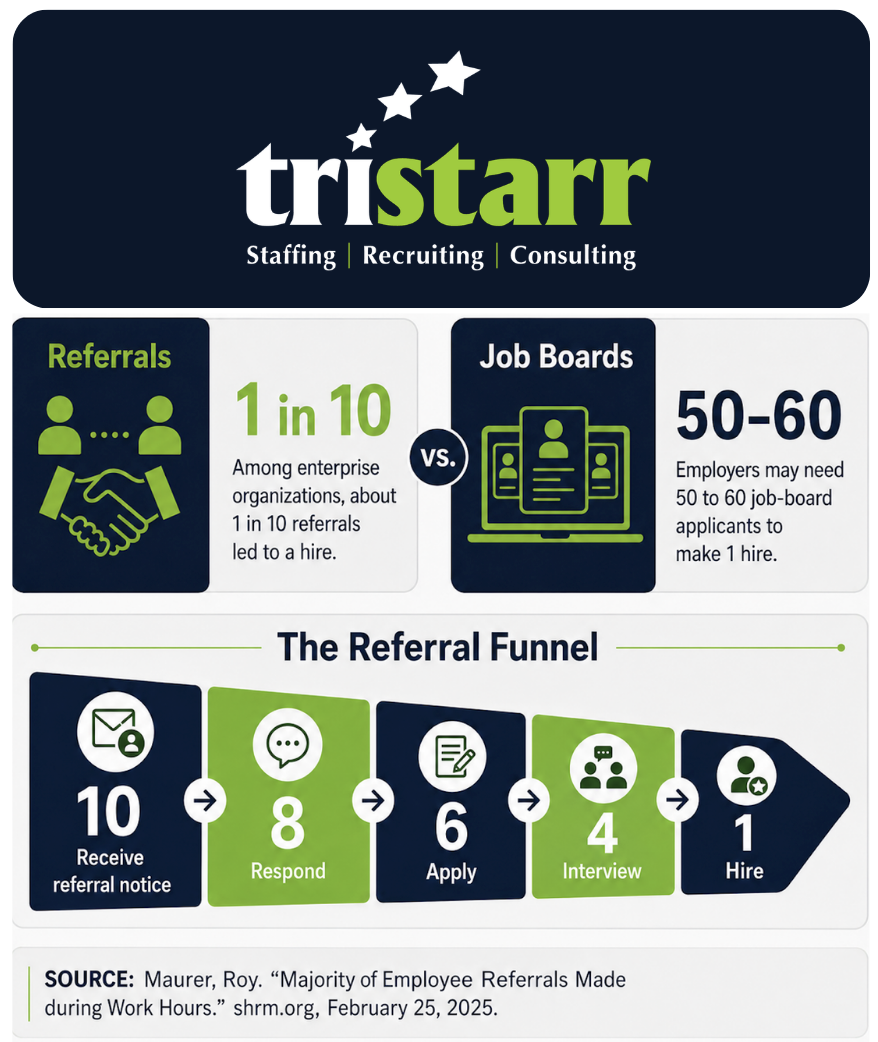
In 2025, the Society for Human Resource Management (SHRM) highlighted an analysis of more than 1.1 million employee referrals(opens in new tab). Among enterprise organizations, about one in 10 referrals led to a hire. In contrast, employers may need more than 50 to 60 job-board applicants to make a single hire.
The referral funnel tells an equally important story. For every 10 people who received a referral notification, eight responded, six applied, four interviewed and one received a job offer.
For HR departments, this does not mean job boards no longer matter. They remain an important recruiting tool. But HR leaders should not mistake application volume for recruiting effectiveness.
Screening 50 applicants may produce less value than engaging a smaller group of candidates who come through trusted professional connections.
Did You Know Referrals Perform Differently?
A study published in The Quarterly Journal of Economics evaluated personnel data from nine large companies across call centers, trucking and high-tech industries. Researchers found that referred applicants were more likely to be hired and more likely to accept job offers. Referred employees were also substantially less likely to quit. In industries where researchers could calculate worker-level profitability, referred employees generated greater profits, with the difference largely attributable to lower turnover and recruiting costs.
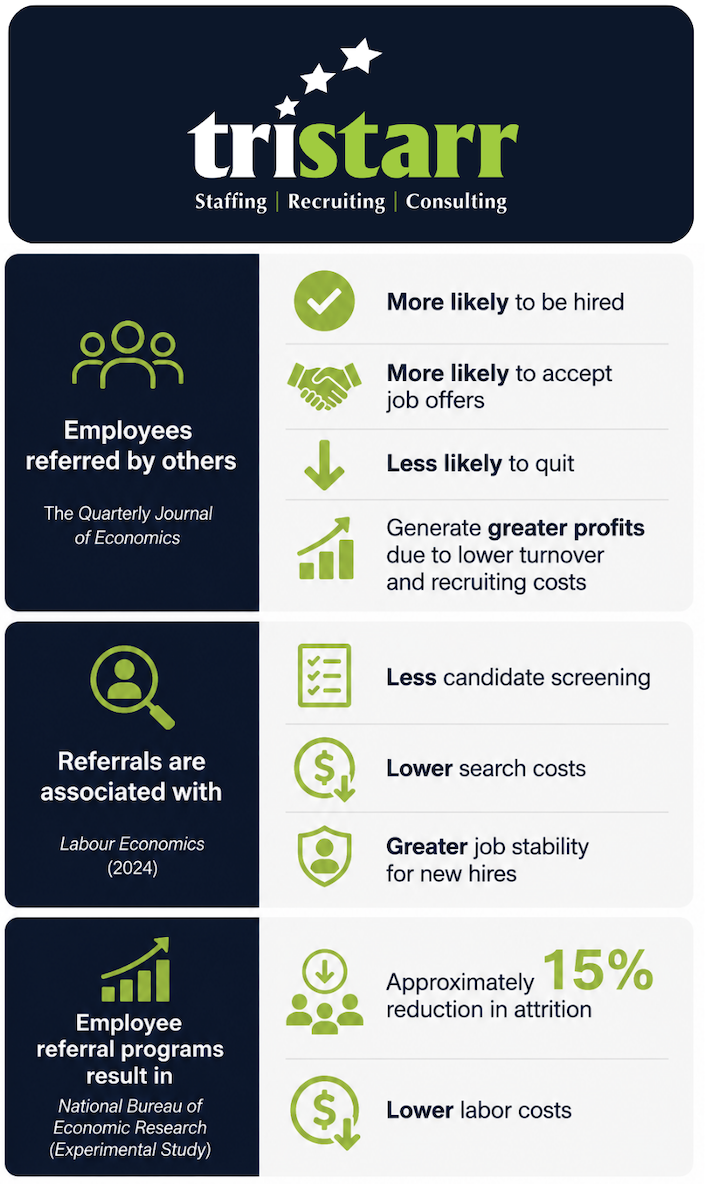 More recent research published in the journal Labour Economics in 2024 reached a related conclusion. Referrals were associated with less candidate screening, lower search costs and greater job stability for new hires. Researchers concluded that referrals can provide employers with information about candidates that may not be captured as efficiently through other recruiting channels.
An experimental study published through the National Bureau of Economic Research adds another dimension. Researchers found that introducing an employee referral program reduced attrition by approximately 15% in the organization studied while also decreasing labor costs.
Collectively, the research suggests that recruiting channels do more than determine where resumes originate. They can affect the information employers have when making hiring decisions and potentially influence retention after the hire.
Did You Know the Candidate You Want May Not Be Applying?
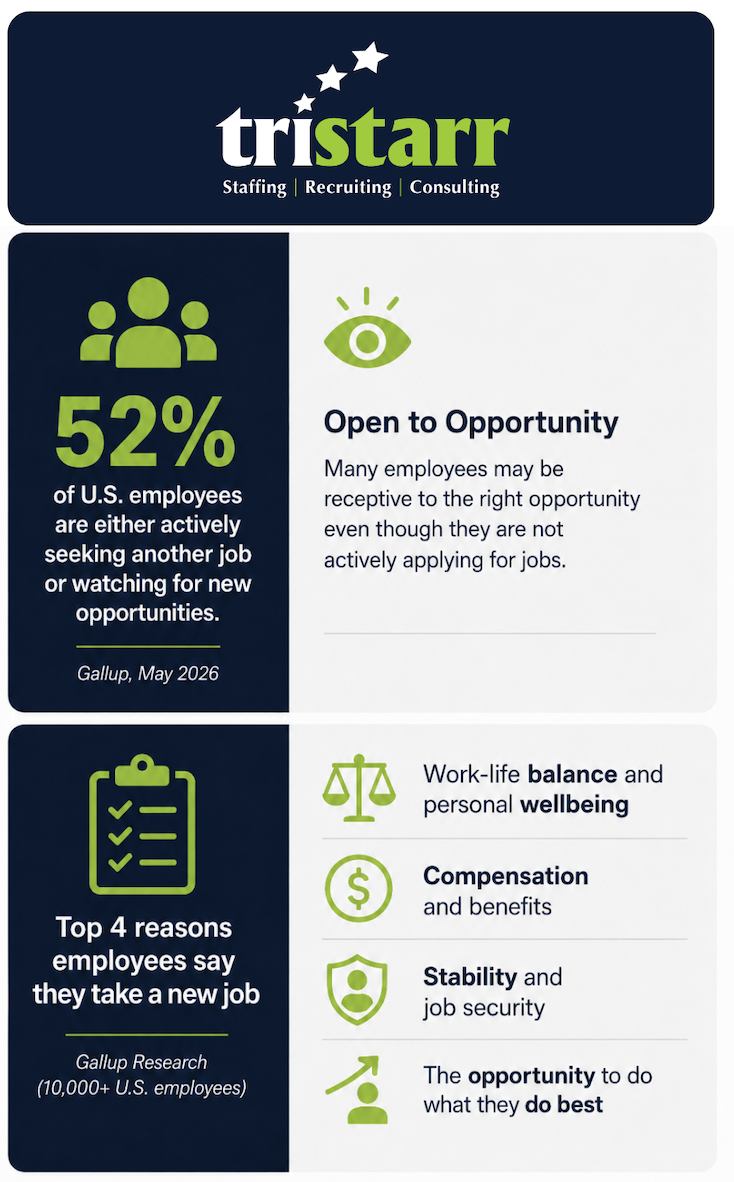 This becomes particularly important when considering the difference between an active applicant and a potential candidate. Gallup reported in May 2026 that 52% of U.S. employees were either actively seeking another job or watching for new opportunities. That means a substantial portion of the workforce may be receptive to the right opportunity even though many are not actively applying for jobs.
What might persuade them to consider a change? Another Gallup research project involving more than 10,000 U.S. employees identified four leading considerations: work-life balance and personal wellbeing, compensation and benefits, stability and job security and the opportunity to do what they do best.
That changes the recruiting conversation. Instead of simply asking, Who has applied for this position?, HR leaders may need to ask, Who would be an excellent fit for this position if we could start the right conversation?
What Does This Mean for Lancaster County HR?
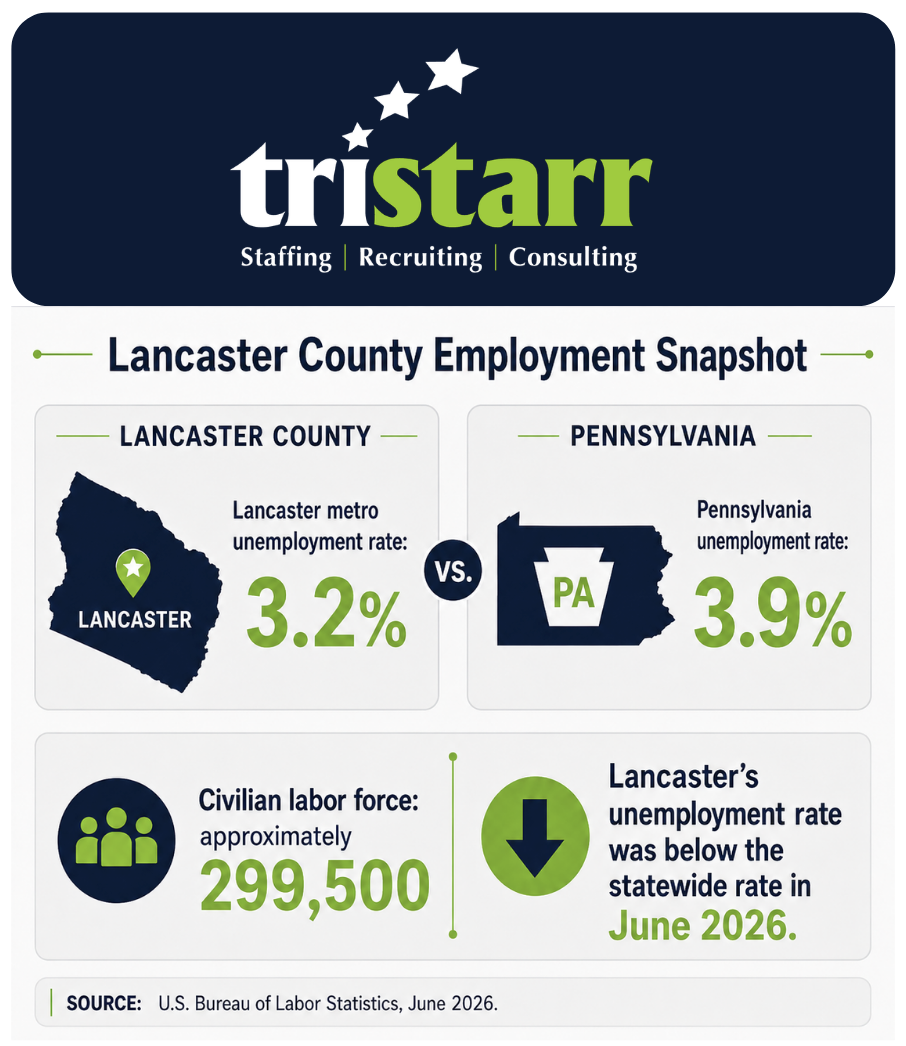 The distinction is particularly relevant to employers in Lancaster County, Pennsylvania. According to the U.S. Bureau of Labor Statistics, Lancaster’s metropolitan unemployment rate was 3.2% in June 2026, compared with 3.9% statewide in Pennsylvania. Lancaster’s civilian labor force was approximately 299,500.
In a labor market with relatively low unemployment, employers cannot assume that the best candidate is currently searching job boards. The next Accountant, HR Manager, Customer Service Representative, IT professional or senior leader an organization needs may already be working somewhere else.
Finding that person requires broader talent networks and, increasingly, relationships. For TriStarr, that is an important distinction. Recruiting is not simply the process of generating applicants. It is the ongoing process of knowing employers, knowing professionals and recognizing when there may be a strong match between the two. For more than 35 years, TriStarr has built relationship with employers and professionals throughout Central PA and beyond. That network allows our team to go beyond the job posting to identify, engage and evaluate talent through temporary staffing, temp-to-hire, direct hire, executive search and other workforce solutions.

Did You Know Many Candidates Never Enter a Traditional Applicant Pool?
For years, HR teams often measured recruiting success by volume: How many people saw the job posting? How many applied? How large did the candidate pool become?
Increasingly, research suggests HR leaders should ask a different question: Where do the strongest candidates come from, and how effectively are we reaching them?
Did you know that in a labor market where many qualified professionals already have jobs, referrals, professional networks, and direct recruiting are an essential part of connecting employers with candidates? In fact, many candidates never enter a traditional applicant pool. More importantly, research shows that these recruiting channels can improve hiring efficiency, strengthen retention and reduce recruiting costs.
Did You Know Referrals Outperform Job-Board Applicants?
In 2025, the Society for Human Resource Management (SHRM) highlighted an analysis of more than 1.1 million employee referrals(opens in new tab). Among enterprise organizations, about one in 10 referrals led to a hire. In contrast, employers may need more than 50 to 60 job-board applicants to make a single hire.
The referral funnel tells an equally important story. For every 10 people who received a referral notification, eight responded, six applied, four interviewed and one received a job offer.
For HR departments, this does not mean job boards no longer matter. They remain an important recruiting tool. But HR leaders should not mistake application volume for recruiting effectiveness.
Screening 50 applicants may produce less value than engaging a smaller group of candidates who come through trusted professional connections.
Did You Know Referrals Perform Differently?
A study published in The Quarterly Journal of Economics evaluated personnel data from nine large companies across call centers, trucking and high-tech industries. Researchers found that referred applicants were more likely to be hired and more likely to accept job offers. Referred employees were also substantially less likely to quit. In industries where researchers could calculate worker-level profitability, referred employees generated greater profits, with the difference largely attributable to lower turnover and recruiting costs.
More recent research published in the journal Labour Economics in 2024 reached a related conclusion. Referrals were associated with less candidate screening, lower search costs and greater job stability for new hires. Researchers concluded that referrals can provide employers with information about candidates that may not be captured as efficiently through other recruiting channels.
An experimental study published through the National Bureau of Economic Research adds another dimension. Researchers found that introducing an employee referral program reduced attrition by approximately 15% in the organization studied while also decreasing labor costs.
Collectively, the research suggests that recruiting channels do more than determine where resumes originate. They can affect the information employers have when making hiring decisions and potentially influence retention after the hire.
Did You Know the Candidate You Want May Not Be Applying?
This becomes particularly important when considering the difference between an active applicant and a potential candidate. Gallup reported in May 2026 that 52% of U.S. employees were either actively seeking another job or watching for new opportunities. That means a substantial portion of the workforce may be receptive to the right opportunity even though many are not actively applying for jobs.
What might persuade them to consider a change? Another Gallup research project involving more than 10,000 U.S. employees identified four leading considerations: work-life balance and personal wellbeing, compensation and benefits, stability and job security and the opportunity to do what they do best.
That changes the recruiting conversation. Instead of simply asking, Who has applied for this position?, HR leaders may need to ask, Who would be an excellent fit for this position if we could start the right conversation?
What Does This Mean for Lancaster County HR?
The distinction is particularly relevant to employers in Lancaster County, Pennsylvania. According to the U.S. Bureau of Labor Statistics, Lancaster’s metropolitan unemployment rate was 3.2% in June 2026, compared with 3.9% statewide in Pennsylvania. Lancaster’s civilian labor force was approximately 299,500.
In a labor market with relatively low unemployment, employers cannot assume that the best candidate is currently searching job boards. The next Accountant, HR Manager, Customer Service Representative, IT professional or senior leader an organization needs may already be working somewhere else.
Finding that person requires broader talent networks and, increasingly, relationships. For TriStarr, that is an important distinction. Recruiting is not simply the process of generating applicants. It is the ongoing process of knowing employers, knowing professionals and recognizing when there may be a strong match between the two. For more than 35 years, TriStarr has built relationship with employers and professionals throughout Central PA and beyond. That network allows our team to go beyond the job posting to identify, engage and evaluate talent through temporary staffing, temp-to-hire, direct hire, executive search and other workforce solutions.
Share This Post